Food, Beverage & FMCG
Vision Copilot for Food and FMCG Operations
Map cameras to the places your team manages and ask Vision Copilot about visible hygiene practices and packaging-flow observations. OrionAlerts analyses scenes over time to surface alerts, recommendations and operational scores that help you decide what to review today and what to improve next.
Illustrative photograph — not a verified customer deployment
Connect visible behaviour with the right operational response.
Busy production areas combine staff movement, cleaning, material handling and packaging activity. A camera may help reveal a visible exception, but food safety depends on controls far beyond what is visible. Keep the monitoring scope tied to defined practices and review events with production context. Non-food FMCG operations should use their applicable product requirements, rather than inheriting food-specific claims.
A reference deployment places cameras at production and hygiene-zone entries and packaging transfer points, using washdown-rated enclosures and cabling suited to the facility's cleaning cycle. Retention should match the window a QA investigation typically needs, with hygiene and packaging-flow alerts routed to food safety and production rather than general security. Where a production-scheduling or batch system is in use, align review timestamps with its records instead of treating video as a stand-alone traceability tool.
Ask your building what needs attention. OrionAlerts maps cameras to your sites, buildings, floors, zones and rooms, analyses scenes over time, and brings the results into Vision Copilot. Search in everyday language, review alerts and recommendations, and use operational scores to guide daily decisions and improvement priorities.
Building intelligence
Your operation, mapped
Organise views around the places the team recognises. Select the location to establish the context for scene observations and Copilot questions. This example uses the shared hierarchy; map the actual site rather than inventing rooms or camera coverage.
See your operation in the structure your team uses. Organise sites, buildings, floors, zones and rooms, then map cameras to their locations. A question about reception, a loading bay or a production area starts with a recognisable place and its available camera context.
Site
Factory
Building
Processing Building
Floor
Production Floor
Zone
Hygiene Zone
Room
Entry Room
Cameras are mapped to the selected packing-area entry or hygiene zone so questions about the packing-area entry start from recognisable operational context.
Vision Copilot
Ask Vision Copilot
Ask what happened. Find where it happened. Decide what to review next. Vision Copilot lets you type questions and search available visual observations in everyday language. Use the mapped location and a relevant period to focus the conversation on the operation you manage.
Illustrative example
Question
Show observations from the packing-area entry this morning.
Five ways teams use this
Use cases for your operation
Bring the right location into the decision
Connect visible hygiene practices and packaging-flow observations to the building tree and its mapped cameras. The team can start with a named operational area instead of trying to remember which camera covers it, making observations easier to interpret and discuss.
Search visual observations in everyday language
Ask Vision Copilot, “Show observations from the packing-area entry this morning.” Use the location and review period to focus the search on relevant available observations. The purpose is to reach useful context without manually working through unrelated camera views.
Identify recurring conditions across scenes
Ask, “Which covered packaging zones show recurring build-up?” Ongoing scene analysis supports review of patterns across the available observations. Use the recurring condition to frame the next investigation rather than treating one isolated alert as the whole operational picture.
Turn analysis into an improvement decision
Ask, “What should the food-safety and production teams review today?” Review the recommendation alongside the underlying observations and the team's operating knowledge. The example below shows a practical next step; it is a suggested action for human consideration, not an automatic instruction to change equipment or procedures.
Use scores to structure the next review
Use 0–100 scores to organise attention across visible hygiene and operational observations, not food contamination or product-safety ratings. Review the contributing observations and coverage before acting. The proposed dimensions for this industry are Visible Hygiene Practices, Packaging-Area Flow and Controlled-Area Practices; use the approved product methodology when demonstrating actual values.
Illustrative decision story
From scenes to decisions
Illustrative decision story — not a customer result. Observe: Visible clothing observations recur at one production entry while nearby staging becomes congested. Ask: “What should the food-safety and production teams review today?” Suggested recommendation: Review the entry layout and staging practice with the responsible teams; verify food-safety controls through the established process. Decide: The responsible team reviews the evidence and agrees an action. Follow up: Revisit the same area and comparable period to assess observations, coverage and score movement. A subsequent change is not proof of causation.
Cameras are mapped to the places your teams manage. Ongoing scene analysis brings observations and alerts into that location context. Use Vision Copilot to ask what happened and what needs attention, review recommendations, and decide on the next action. Return to the same scope and a comparable period to assess the observations and scores after a change.
Observed
Visible clothing observations recur at one production entry while nearby staging becomes congested.
Recommendation
Review the entry layout and staging practice with the responsible teams; verify food-safety controls through the established process.
Follow up
Revisit the same area and comparable period to assess observations, coverage and score movement.
Operational scores
See what needs attention—and what changes after action.
Bring visible hygiene practices and packaging-flow observations into a structured review with operational scores out of 100. Use the score alongside the location, period and contributing observations to decide where to focus. Compare visible hygiene and operational observations only when the assessment basis is consistent; never treat these scores as food contamination or product-safety ratings.
Proposed score names and formulas are design recommendations. Demonstrate only approved product values or clearly labelled illustrative states. If no valid opportunities exist, show Not assessed — never invent a flattering percentage.
Visible practices
Visible Hygiene Practices
Not assessed
Proposed dimension · proposal-3.2
A specified visible hygiene clothing item meets the agreed criterion at an observable production entry.
Flow
Packaging-Area Flow
Not assessed
Proposed dimension · proposal-3.2
A sampled visible accumulation or occupancy at a defined packaging transfer point stays within the agreed operational threshold.
Access practices
Controlled-Area Practices
Not assessed
Proposed dimension · proposal-3.2
Reviewed entry into a configured production zone follows the agreed schedule or access rule for the review period.
Score presentation context
- Period
- Comparable production window
- Scope
- Selected hygiene and packaging zones with mapped cameras
- Coverage
- Monitoring Coverage shown separately when assessment windows are defined
- Evaluated checks
- Not assessed — awaiting approved product dataset
Deployment
Start with the cameras, conditions and decisions that matter.
A useful deployment starts with a defined problem. Review camera coverage, operating hours, lighting, network capacity and who will respond to an alert. Select a small set of observable events, agree how to assess them and expand after the pilot demonstrates useful results. Test washdown conditions, condensation, reflective packaging and protective clothing variations. Keep cameras compatible with the physical environment and avoid claiming contamination detection from general surveillance.
- Mapped hierarchy for pilot hygiene entries and packaging zones
- Agreed response owners for visible hygiene and packaging-flow events
- Camera placement plan compatible with washdown and condensation conditions
- Representative testing across clothing variations and packaging reflectivity
- Washdown-rated camera enclosures and cabling confirmed against the facility's cleaning cycle before installation
Standards boundary
Standards and procurement considerations
Food businesses should assess applicable FSSAI licensing and Schedule 4 requirements. ISO 22000 is a food-safety management-system standard; video does not provide certification.
FSSAI / food safety management context
A general logistics page must not imply a universal food or logistics certificate. Apply food-storage obligations only where the operation handles food.
How to evaluate a pilot
What to measure in a pilot
Pilot results depend on scene conditions and event definitions. Compare reviewed alerts with representative ground-truth observations, including missed events. Track nuisance alerts and response times before setting a wider rollout target. The measures shown here are evaluation criteria, not guaranteed improvements.
Reviewed clothing observations against labelled samples
Confirmed relevant visible hygiene-clothing observations divided by reviewed alerts for the defined entries, using a QA-approved review rubric.
Source of truth: QA-approved samples and supervisor review log
Packaging-area event review time
Time for an authorised reviewer to locate the correct packaging-area clip from a defined starting input such as time window and zone.
Source of truth: Response records and timed retrieval exercises
Investigation-footage availability
Share of expected assessment windows at priority cameras that remained usable for investigation during the pilot period.
Source of truth: Recording logs and surveillance health records
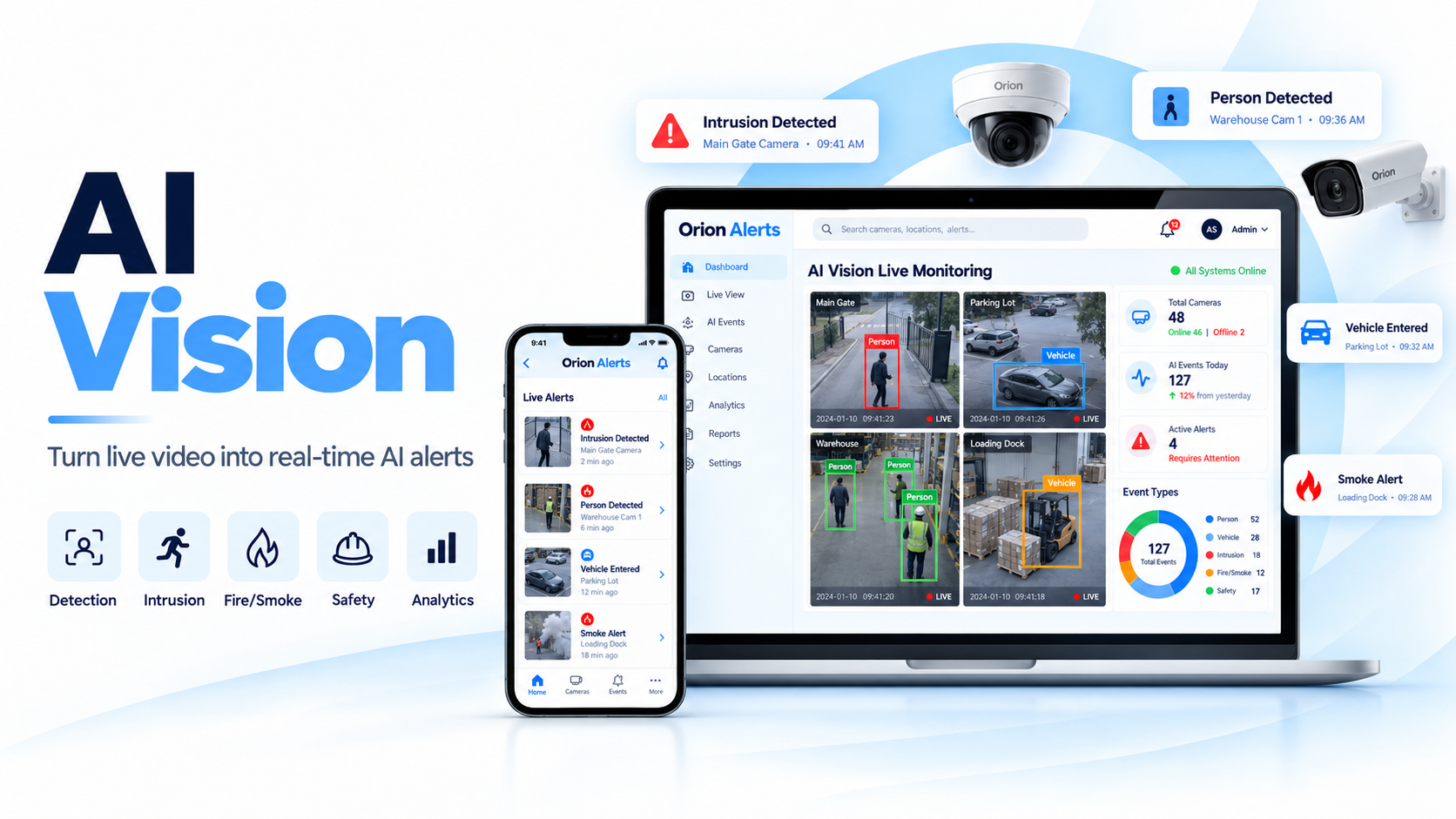
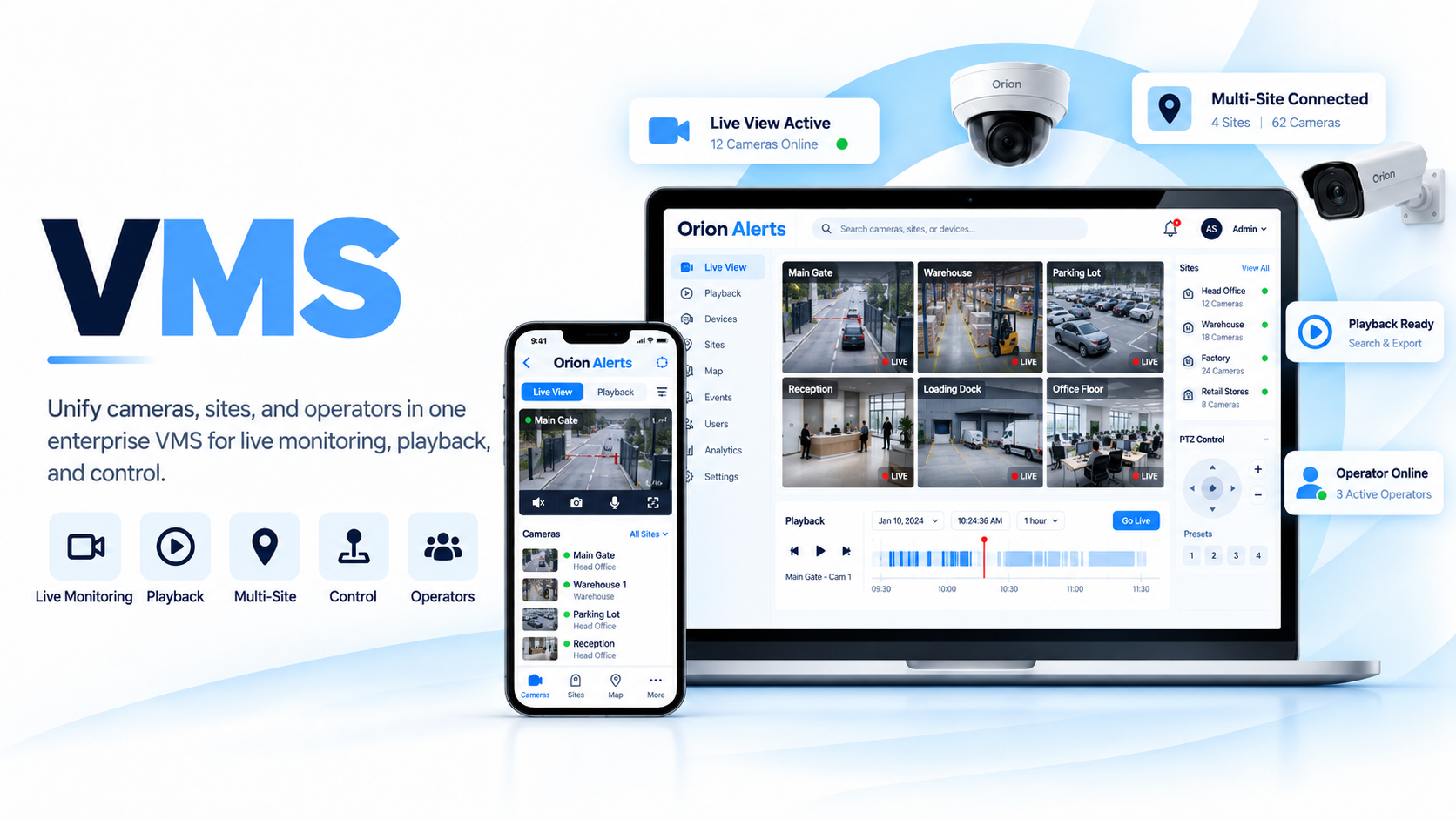
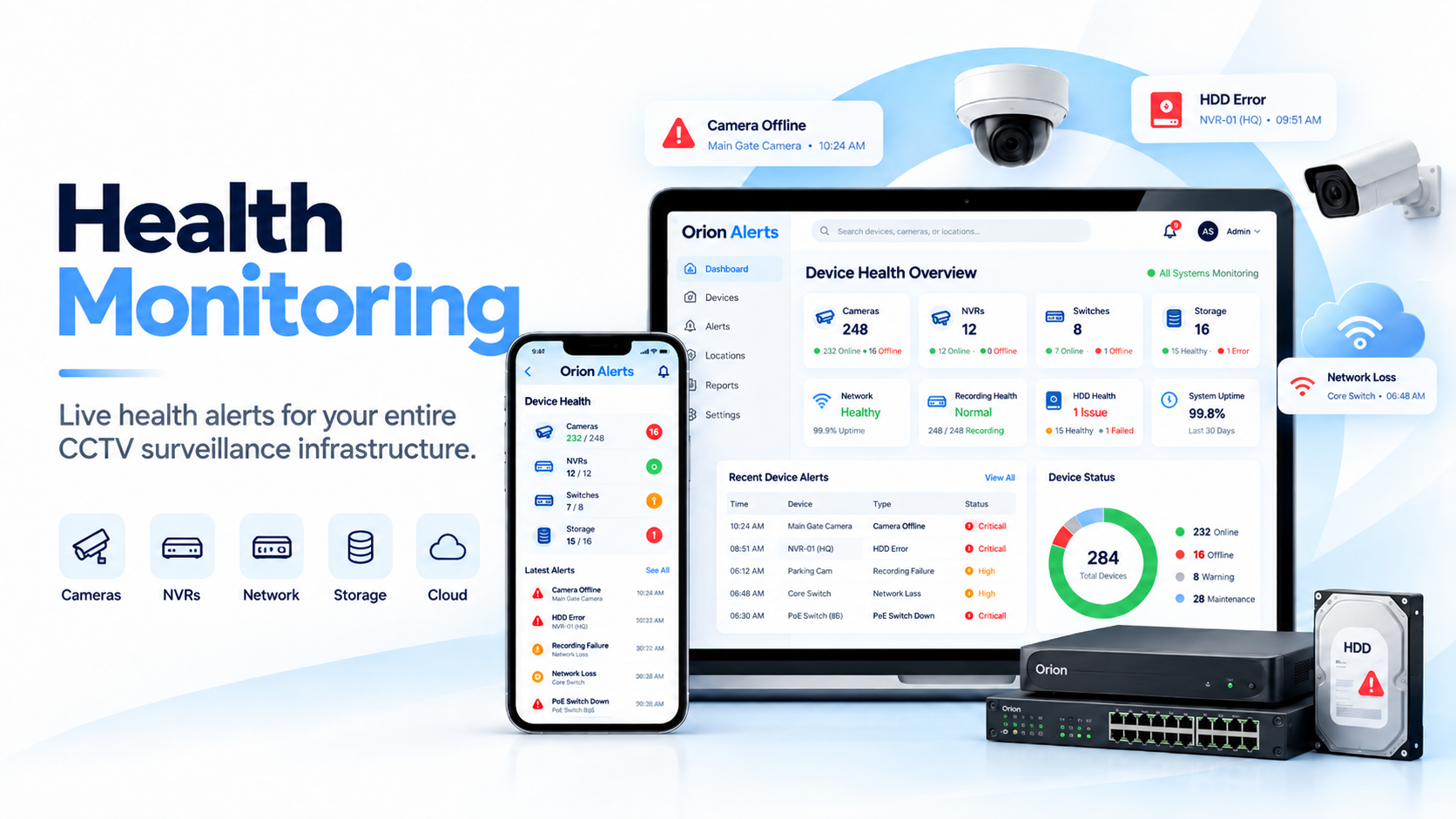
Recommended OrionAlerts solutions
Common questions
Frequently asked questions
Can cameras detect food contamination?
Ordinary CCTV cannot establish microbial or chemical safety. Use validated testing and process controls.
Can this support an audit?
Relevant footage may support a review if its handling and use are appropriate. It does not replace required records or inspections.
Does this apply to all FMCG?
Visual access and workflow use cases can apply broadly. Food-specific requirements only apply to the relevant food operations.
What is Vision Copilot?
Vision Copilot is OrionAlerts' conversational interface for asking questions and searching available visual observations. It uses the mapped operational context to help teams review what needs attention and consider relevant next steps.
Why map cameras to a building tree?
A camera becomes more useful when its view is connected to a place the team recognises. The hierarchy connects sites, buildings, floors, zones and rooms with their cameras, giving searches and operational reviews a consistent location context.
What do scores out of 100 mean?
Scores help organise review of observed conditions. Read each score with its stated assessment basis, location, period and supporting observations. A score is not a certificate of safety or compliance, and missing observations do not prove that conditions are satisfactory.
Can recommendations guide property improvements?
Recommendations can help your team identify issues to inspect and changes to assess, such as staging arrangements, access practices or camera coverage. Review the evidence and operational constraints before deciding on a change; outcomes are not guaranteed.
Can we use our existing CCTV cameras?
Compatible IP camera streams may be reused after a technical assessment. Camera position, image quality, supported stream formats, network access and available compute determine which use cases are practical. Confirm the selected cameras and deployment architecture before rollout.
How should video access and retention be planned?
Define the purpose of monitoring, authorised users, retention period and incident-review process before deployment. Discuss the required access, storage and privacy controls during the assessment and verify what the selected configuration supports. Apply your organisation's policies and the requirements relevant to your location and people being recorded.
Related industries


Ask Vision Copilot about your food and fmcg operations.
See how Vision Copilot connects a mapped area with visual search, recommendations and scores for food and fmcg operations.
