Why Traditional CCTV Monitoring Is No Longer Enough
Passive recording and manual footage review cannot keep up with modern security and operational demands. AI video analytics turns existing cameras into real-time intelligent sensors.

Key takeaways
- 01Passive CCTV creates evidence after the fact — not decisions in the moment.
- 02Operator bandwidth does not scale linearly with camera count.
- 03AI Vision turns existing cameras into prioritized exception sensors.
For years, enterprise security teams treated CCTV as a recording system: install cameras, store footage, review clips after something goes wrong. That model still has value for investigations — but it no longer matches how modern plants, campuses, and logistics sites actually operate.
The hidden cost of passive monitoring
As camera estates grow, the gap between visibility and action widens. A site may have hundreds of feeds, yet only a handful of operators. Most events are missed in real time, then reconstructed later under pressure. The result is slow response, incomplete context, and fatigue.
- Manual monitoring cannot watch every zone continuously
- Incident review becomes a scrubbing exercise across NVRs
- Low-signal noise competes with true operational exceptions
- Multi-site estates lose a shared operating picture
More cameras without smarter triage does not create safer operations — it creates more footage to ignore.
From recording to real-time intelligence
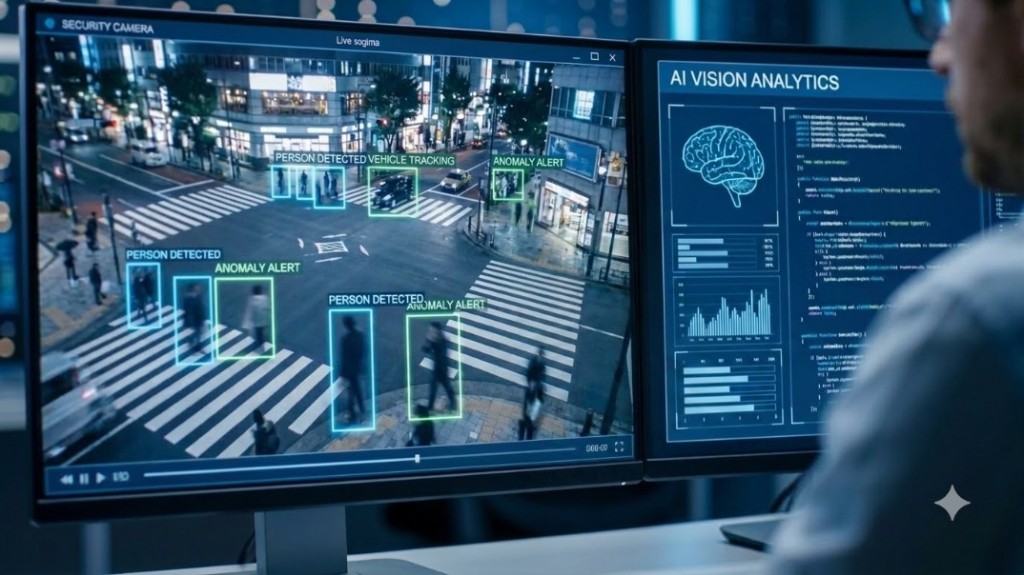
AI video analytics changes the job. Instead of asking operators to stare at walls of video, the system continuously evaluates streams for intrusion, PPE exceptions, crowding, restricted-zone entry, and other policy events — then routes high-confidence alerts with evidence context.
That shift is what turns CCTV from a passive archive into an operational sensor network. Existing cameras stay in place. The upgrade is the intelligence layer on top: prioritized alerts, searchable video, and multi-site command.
What good looks like for enterprise teams
High-performing teams do not eliminate human judgment — they protect it. They give operators fewer, better signals; they shorten investigation cycles with smart search; and they keep camera estates healthy so blind spots do not appear silently overnight.
If your current model depends on someone noticing the right feed at the right second, it is already behind the operational reality of modern facilities. The next standard is simple: detect early, notify the right role, and investigate with evidence that is already organized.
Keep reading
Related articles
Operations
Transforming CP Plus Surveillance into Intelligent Video Infrastructure with Orion Alerts
Installing high-quality cameras is only the first step towards building an effective surveillance system.

Operations
Alert Fatigue Is an Ops Problem
More cameras do not equal better coverage. Prioritized AI alerts help operators respond faster without drowning in low-signal noise.