CCTV AMC Management Checklist: SLAs, Preventive Maintenance and Vendor Scorecards
A practical CCTV AMC checklist: what the contract should cover, how to set SLAs, what preventive maintenance includes and how to score vendors.
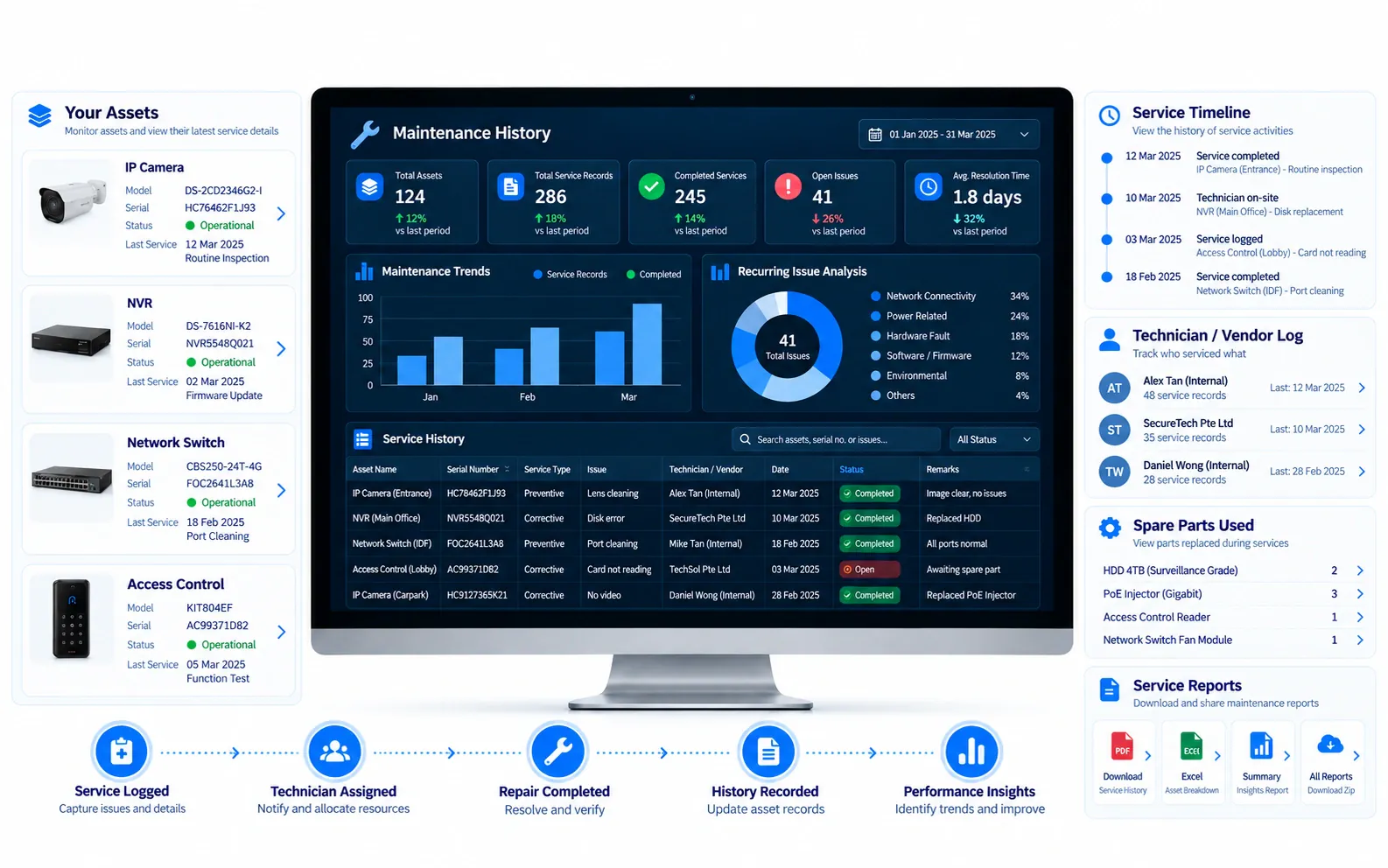
Key takeaways
- 01A CCTV AMC is only enforceable if it lists every covered device, defines priorities and states response and resolution targets for each.
- 02Preventive maintenance should verify recording and retention, not only clean lenses and check cables.
- 03Score vendors on SLA adherence, preventive maintenance completion, repeat faults and reporting quality, using ticket data rather than impressions.
- 04Link the AMC to an asset register and camera health alerts so faults become tickets against the right contract automatically.
Short answer: Managing a CCTV AMC (annual maintenance contract) well comes down to four things: a contract that lists every covered device with clear priorities and response and resolution targets, a preventive maintenance checklist that proves cameras are recording, tickets that track every fault to closure, and a vendor scorecard built from that ticket data. The checklist below covers each of them.
In India, organizations with a sizeable camera estate commonly rely on one or more vendors under an AMC to keep cameras, recorders and cabling working. The contract is signed once a year; the problems show up every day. Without a clear structure, it is hard to know whether the AMC is delivering what it promised.
What is a CCTV AMC?
A CCTV AMC is a yearly service contract in which a vendor maintains your surveillance equipment, usually covering preventive visits and repairs for a defined list of devices.
AMCs are commonly offered as comprehensive, where spare parts are included, or non-comprehensive, where the vendor provides labor and parts are billed separately. Which one makes sense depends on the age of the estate and how predictable you need maintenance spend to be. Our glossary entry on the AMC (annual maintenance contract) covers the basics.
What should a CCTV AMC contract include?
Write the contract so that any dispute can be settled by looking at the asset list and the ticket history.
- Asset schedule: every covered camera, recorder, disk, switch and power device, with serial number and location
- Coverage type: comprehensive or non-comprehensive, and which parts or consumables are excluded
- Preventive maintenance: frequency of visits and the checklist each visit must complete
- Priorities and SLAs: response and resolution targets for each priority level
- Escalation matrix: named contacts at both ends, and when each level is involved
- Spares and standby: whether the vendor keeps critical spares or provides standby units
- Reporting: what the vendor must report, how often and in what format
- Access and security: rules for remote access, passwords and who can change configurations
- Remedies: what happens when SLAs are missed, and the conditions for renewal or termination
How should CCTV AMC SLAs be defined?
Define priorities by the impact of the fault, then agree response and resolution targets for each priority that fit your risk and your sites.
| Priority | Example fault | What to agree |
|---|---|---|
| Critical | Recorder down, a whole site not recording, perimeter cameras offline | Fastest response and resolution, on-site attendance, standby equipment |
| High | Several cameras offline in a sensitive area | Short response, resolution within the next working window |
| Medium | Single camera offline, degraded image or night performance | Response and resolution within scheduled working hours |
| Low | Cosmetic issues, documentation, minor configuration changes | Handled at the next preventive visit |
Two details make SLAs enforceable. First, define when the clock starts: when the fault is detected or reported, not when the vendor acknowledges it. Second, measure response (someone is working on it) separately from resolution (the camera is recording again). Targets that are not measured from ticket timestamps are hard to enforce.
What belongs in a preventive maintenance checklist?
Each preventive visit should leave the estate verifiably recording, with evidence, not just cleaned.
- Clean lenses, domes and housings, and remove obstructions such as cobwebs or foliage
- Compare each view with a reference image to catch cameras that have shifted or lost focus
- Check night performance, IR illumination and backlight compensation
- Inspect mounts, cabling, connectors and weatherproofing
- Check power supplies, PoE budgets and UPS backup
- Check recorder health: disks, fans, temperature, error logs and free capacity
- Verify that every channel is recording and that retention meets the policy
- Confirm time synchronization on cameras and recorders
- Apply approved firmware updates under change control
- Review user accounts and default passwords
- Record findings per device, with photos where useful, against the asset register
How do you build a vendor scorecard?
Score vendors on outcomes you can measure from tickets and visit records, reviewed monthly and summarized for the renewal decision.
| Metric | How to measure it |
|---|---|
| Response SLA adherence | Share of tickets responded to within target, by priority |
| Resolution SLA adherence | Share of tickets resolved within target, by priority |
| Preventive maintenance completion | Visits completed on schedule, with a full checklist |
| Repeat faults | Devices that fail again soon after a fix |
| Estate availability | Camera availability and recording completeness for covered sites |
| Reporting quality | Reports delivered on time, complete and accurate |
Keep the scorecard factual. Data from SLA tracking and camera health monitoring is harder to argue with than a list of complaints.
How do you manage renewals and warranties?
Track every device's warranty and AMC coverage in one register, and get reminders well before anything expires.
New devices are often under manufacturer warranty when the AMC starts, so check for overlaps rather than paying twice. Devices that leave the estate should come off the asset schedule. And renewals should start early enough to use the scorecard in negotiations, rather than renewing automatically because time ran out. A live asset register with serial numbers, locations and documents makes all of this easier. Our guide to building a live camera and NVR register covers what to record for each device.
What are the most common AMC mistakes?
Most AMC problems trace back to a vague contract or an untracked fault.
- An asset list that is out of date on the day the contract is signed
- Preventive visits that are signed off without verifying recording
- Faults reported by phone or email with no ticket number or timestamp
- One SLA for everything, so critical outages wait behind minor issues
- No link between camera health alerts and the vendor who must fix them
How does OrionAlerts help manage CCTV AMCs?
OrionAlerts includes AMC Management alongside Asset Tracking and Health Monitoring, so contracts sit on the same records as the devices they cover.
The module tracks AMC and warranty coverage against each asset and schedules preventive maintenance across sites. Service requests are logged from intake through vendor dispatch to closure. Vendors are measured on response time, completion quality and repeat issues against their SLAs, and at-risk tickets are flagged early. Reminders go out before AMC, warranty and contract renewals and preventive visits fall due.
Because Nebula OS links health events to the contract already attached to each device, a camera that fails can generate a ticket for the responsible vendor automatically, instead of waiting for someone to notice and phone it in. Read CCTV camera health monitoring for how faults are detected in the first place.
FAQs
What is the difference between a comprehensive and a non-comprehensive CCTV AMC?
A comprehensive AMC includes spare parts in the contract price, while a non-comprehensive AMC covers labor and visits and bills parts separately. Always check the exclusions list in either case: comprehensive contracts often still exclude physical damage, consumables or cabling, and non-comprehensive contracts should state how parts are quoted and approved.
How often should CCTV preventive maintenance be done?
It depends on the environment and the contract. Dusty, outdoor or industrial sites need more frequent visits than clean indoor sites. Agree a frequency per site type, write it into the contract and track completion, and use health data to bring a visit forward when a site shows repeat faults.
Who should own the AMC inside the organization?
One named owner, usually in facilities, administration or IT, should hold the contract, the scorecard and the renewal, with security and site teams raising and verifying tickets. That owner reviews the scorecard with the vendor every month and starts the renewal discussion well before the contract ends.
Can AMC management be automated?
Much of it can: asset and contract records, preventive maintenance schedules, ticket routing, SLA timers, reminders and scorecards. Site checks and repairs still need people. Automation works best when camera health alerts create tickets directly, so the SLA clock starts when a fault is detected rather than when someone reports it.
Keep reading
Related articles
Asset & AMC · 26 Oct 2026 · 8 min read
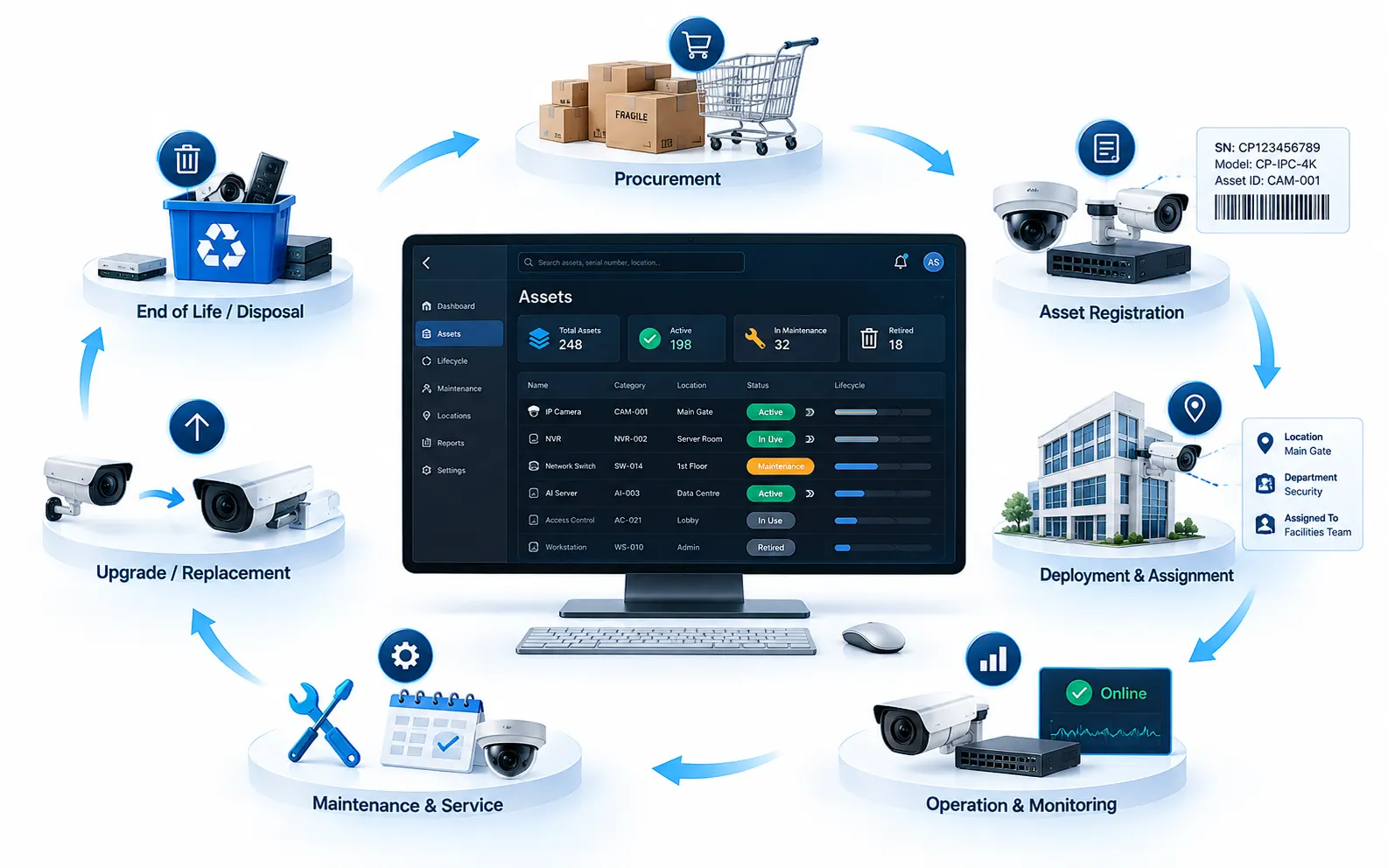
Surveillance Asset Management: Building a Live Camera and NVR Register Across Sites
Build a live register of cameras, NVRs and network devices across sites: what to record, custody, warranty, lifecycle and keeping it in sync.
Camera Health · 26 Oct 2026 · 7 min read
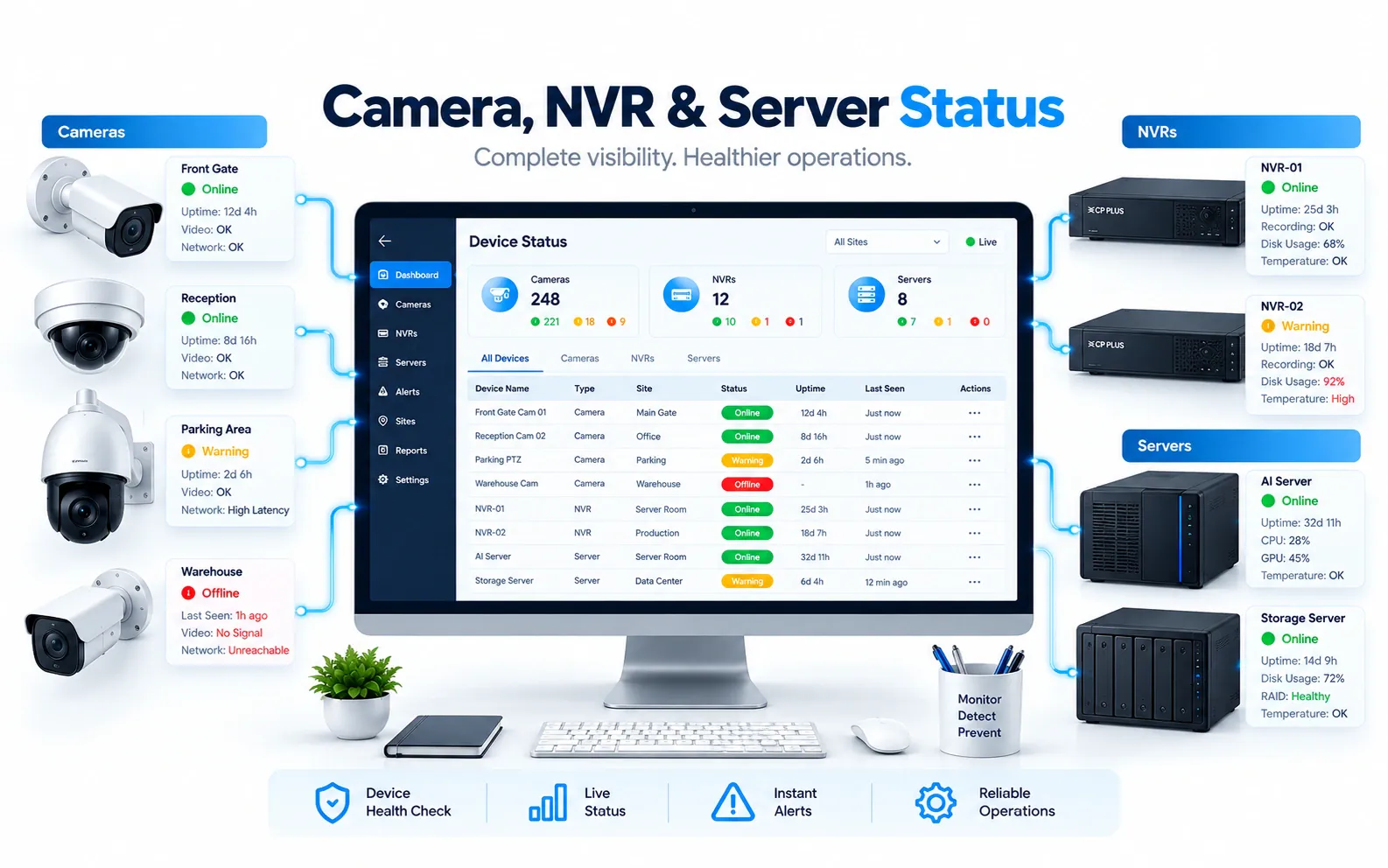
CCTV Camera Health Monitoring: Detect Offline Cameras and Recording Gaps Before an Incident
How CCTV camera health monitoring finds offline cameras, blocked views and recording gaps before an incident, and what checks and metrics to use.